
React vs Flutter vs React Native: Which One Should You Choose?
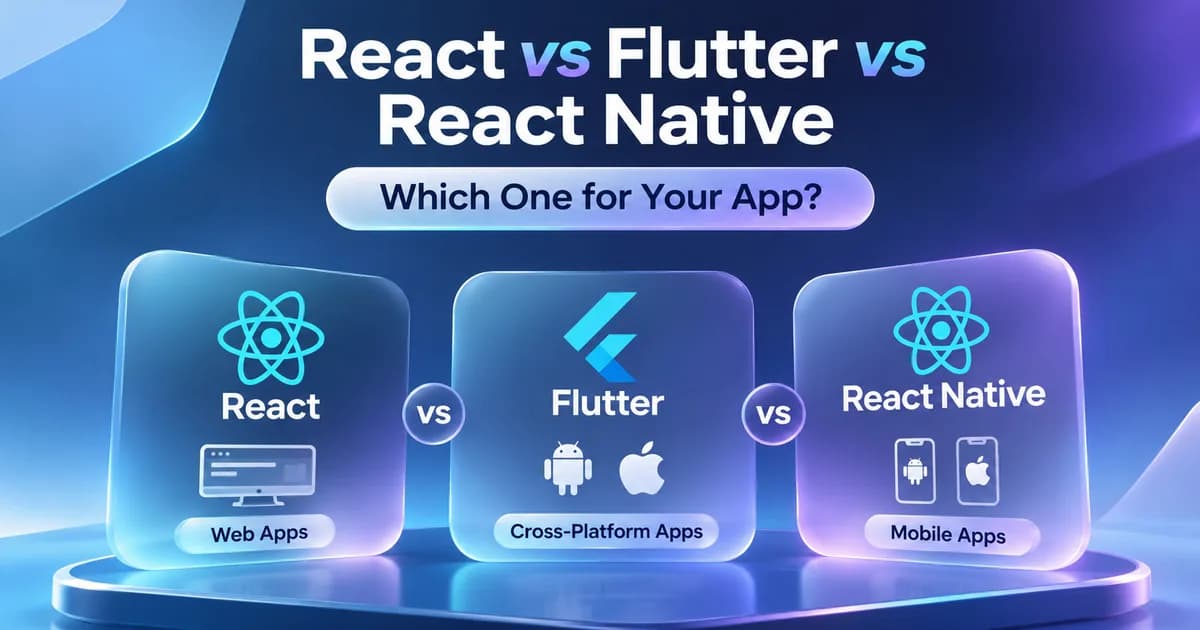
Choose React to build a website or web app, React Native to build a mobile app with a team that already knows JavaScript or React, and Flutter to build a mobile app with a highly custom design that looks identical on every device. All three are popular and well supported, so the right one depends on what you are building and who will build it, not on which is "best". This guide explains each in plain English, compares them side by side, and gives you a simple way to decide.
If you want a recommendation for your own project, tell us what you are building and we will reply within 24 hours. You can also chat with us on WhatsApp (opens in a new tab).
Quick answers
- React: a JavaScript library for building websites and web apps. It does not build mobile apps by itself.
- React Native: a framework that uses React and JavaScript or TypeScript to build iOS and Android apps from one codebase.
- Flutter: Google's framework that uses the Dart language to build iOS and Android apps (and web and desktop) from one codebase.
- Most common mix-up: React and React Native are different tools. They share ideas and skills, but one targets browsers and the other targets phones.
- Cost: the framework you choose matters less than scope, design, and team seniority. See our mobile app cost guide.
What each one is
React
React is a library for building user interfaces on the web. You describe your screens as components, and React updates the page when data changes. It powers a large share of modern websites and web apps, usually together with a framework such as Next.js. Choose it when your product lives in the browser.
React Native
React Native lets you build mobile apps using the same ideas as React. You write in JavaScript or TypeScript, and the framework renders real native interface elements on iOS and Android. A team that already builds React web apps can share skills, and sometimes some logic, with the mobile app.
Flutter
Flutter is a toolkit from Google. You write in Dart, and Flutter draws every pixel of the interface itself instead of using the platform's built-in elements. That gives you precise control over how the app looks, and it looks the same on iOS and Android. Flutter can also target web and desktop from the same code.
Side-by-side comparison
| Feature | React | React Native | Flutter |
|---|---|---|---|
| Builds | Websites and web apps | iOS and Android apps | iOS and Android apps (also web and desktop) |
| Language | JavaScript or TypeScript | JavaScript or TypeScript | Dart |
| Made by | Meta and community | Meta and community | |
| How the screen is drawn | Browser | Native platform elements | Flutter's own rendering engine |
| Look and feel | Your own web design | Feels like each platform by default | Identical on every device, fully custom |
| Reuse from a React web team | Direct | High (skills and some logic) | Low (new language and tools) |
| Best for | Web products | Mobile apps from a JavaScript team | Design-heavy apps and consistent branding |
When to choose each
Choose React when
- You are building a website, dashboard, SaaS product, or admin portal that runs in the browser.
- You want strong search visibility, especially with a framework such as Next.js.
- You do not need a downloadable app yet. A good web app is often the cheapest first step.
Choose React Native when
- You need iOS and Android apps and already have, or can hire, React or JavaScript developers.
- You also have a React web app and want to share skills and some business logic.
- You want an interface that follows each platform's usual look and behaviour.
- You want to hire from a large pool of JavaScript and TypeScript talent.
Choose Flutter when
- Your design is highly custom, with animations and a branded look that must match exactly on every device.
- You want one team and one codebase for mobile, and possibly web and desktop later.
- You are starting fresh and are happy to adopt Dart.
- You care about consistent behaviour across many Android devices and OS versions.
What about native apps?
Fully native apps use Swift for iOS and Kotlin for Android, with a separate codebase for each. They give the deepest access to each platform and the best fit for very demanding features such as advanced graphics or heavy hardware use. They also cost more because you build and maintain two apps. For most business apps, a cross-platform framework is a better value. If you are not sure whether your app needs native, ask us before you decide.
How the choice affects cost
The framework itself is free. What you pay for is the team's time. Cross-platform frameworks usually cost less than building two native apps because one team builds both. Between React Native and Flutter, the price difference is usually small compared with scope, design, and integrations.
At TechieBall, a dedicated developer costs USD 2,400 to 7,200 per month and hourly work costs USD 15 to 45, whichever of these skills you need. Read our mobile app cost guide for a breakdown by app type, and our guide to the cost of hiring a developer in India for the full pricing model.
How the choice affects hiring
Hiring is often the deciding factor.
- React and React Native: JavaScript and TypeScript are very widely known, so the hiring pool is large. A React web developer can often move to React Native more easily than to Flutter.
- Flutter: the community is strong and growing, but Dart developers are fewer than JavaScript developers in most markets. Hire people who have shipped real Flutter apps.
- Whichever you choose: ask to see published apps, ask who will actually write the code, and agree on code review and testing.
When you are ready, you can look at our hiring pages for React developers, React Native developers, and Flutter developers. If you also need a back end, see Node.js developers and Python developers, and for AI features see AI developers. Or look at our general hiring page.
A simple way to decide
Answer these four questions in order:
- Is it a website or web app, not a phone app? Choose React (usually with Next.js).
- Do you already have React or JavaScript developers, or a React web product? Choose React Native.
- Is a custom, pixel-perfect brand design the priority? Choose Flutter.
- None of the above? Pick the framework whose developers you can hire most easily and who have shipped apps similar to yours. That is often the safest choice.
If two options are close, build a small first milestone in your top choice. It costs little and shows you how the team and the tool work for your project before you commit the full budget.
Common mistakes
- Choosing by hype. A framework that is popular on social media is not necessarily the best fit for your app.
- Mixing up React and React Native. They are related but not interchangeable.
- Ignoring the team. A strong team in the "second-best" framework beats a weak team in the "best" one.
- Skipping the web. Some products do not need a mobile app at the start. A good web app can launch faster and cheaper.
- Over-engineering version one. Ship a focused MVP first, then grow.
Frequently asked questions
Is React the same as React Native?
No. React builds websites and web apps that run in a browser. React Native uses React's ideas to build iOS and Android apps. They share concepts and skills, but they are separate tools.
Is Flutter better than React Native?
Neither is better in every case. Flutter is strong for custom, consistent designs. React Native is strong when your team already works in JavaScript or React and wants a platform-native feel. Choose by your design needs, your team, and your hiring options.
Which is cheaper, Flutter or React Native?
Usually there is little difference. Cost depends far more on features, design, integrations, and the team's seniority than on the framework. Both are cheaper than building two separate native apps.
Can I build both a website and a mobile app?
Yes. Many teams use React (with Next.js) for the website and React Native for the mobile app so they can share skills and some logic. Flutter can also cover mobile, web, and desktop from one codebase, though web apps built with it are not the same as search-friendly websites.
Which one is easier to hire for?
JavaScript and TypeScript developers, and so React and React Native developers, are generally easier to find than Dart developers. That can shorten hiring. Always check for apps they have already shipped.
Do I need native Swift and Kotlin instead?
Only if your app depends on very demanding platform features or needs the deepest hardware access. For most business apps, a cross-platform framework gives a better balance of cost and quality.
How do I choose for my project?
Tell us what you are building, including your users, must-have features, and any existing code or team. We reply within 24 hours with a recommendation and an estimate. You can also read about our mobile app development service.
Ready to build?
Share your idea and we will recommend a stack and reply within 24 hours with matched developers and a quote in your currency.